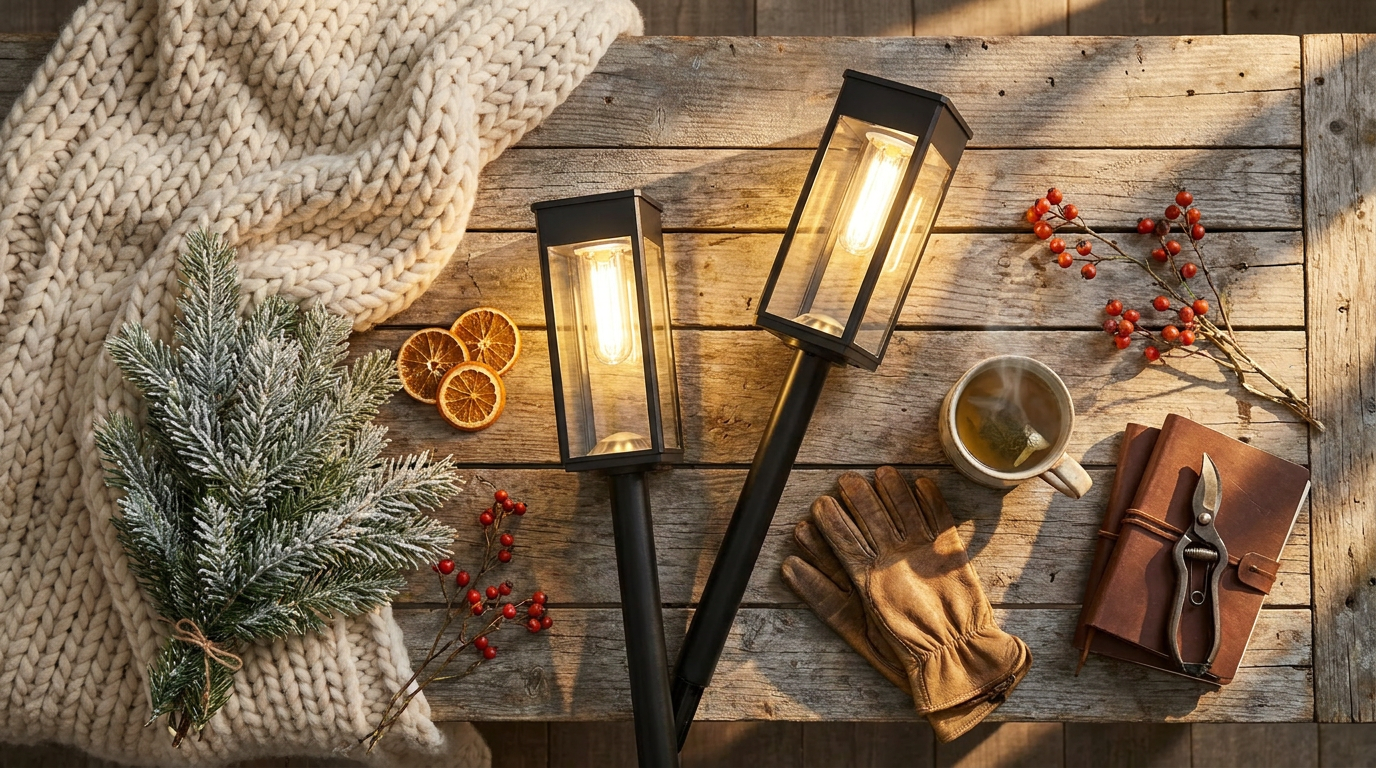
Can Waterproof Solar Garden Pathway Lights Work in Winter?

July 5, 2026 — While cold temperatures do not prevent solar energy absorption, the reduced daylight hours and lower sun angle during winter months typically decrease the total lumen output and duration of Waterproof Solar Garden Pathway Lights with Automatic On And Off compared to summer performance.
Homeowners often assume that freezing temperatures are the primary enemy of outdoor solar installations, leading many to unnecessarily dismantle their landscape lighting in October. In reality, the thermal environment is less critical than the solar geometry and the integrity of the unit's seal against moisture ingress. The conventional wisdom says to store these units indoors for the season, but high-quality hardware is engineered to remain stationary if specific maintenance protocols are observed.
How do shorter days affect automatic solar landscape lighting?
Run the math: a solar panel requires approximately six to eight hours of direct sunlight to reach full capacity, yet peak winter sun in northern latitudes often drops below five hours of high-intensity light. The Waterproof Solar Garden Pathway Lights with Automatic On And Off utilize a dusk-to-dawn sensor that triggers the light as soon as ambient levels fall, which happens much earlier in winter. According to technical data from Solar-Eye, solar lights will function in winter, but users must expect a significantly reduced runtime because the battery rarely reaches a full state of charge. The performance gap isn't a failure of the battery chemistry, but rather a deficit in the energy harvest. To mitigate this, experts at Homes & Gardens suggest changing the angle of the solar panel to be more perpendicular to the sun's lower winter arc, ensuring every available photon is captured during the abbreviated daylight window.
Does moisture and snow damage waterproof solar pathway lights?
Here's the part nobody talks about: the most common failure point in winter isn't the cold, but the freeze-thaw cycle that forces moisture into micro-fissures in the housing. A true waterproof rating is essential because snow accumulation sitting on the lens eventually melts and can seep into internal electronics if the seals are not marine-grade. Streetlights Solar emphasizes that ensuring lights are tightly sealed is the only way to prevent internal component corrosion during high-moisture months. I’ll change my mind about the durability of these units when I see a non-waterproof model survive a standard Midwestern winter without circuit degradation. Furthermore, snow must be manually cleared from the top of the Waterproof Solar Garden Pathway Lights with Automatic On And Off; even a thin layer of frost can reduce energy absorption by 50% or more, rendering the automatic on-off feature useless as the battery drains to zero.
Quick answers
Q: Should I cover the solar panels with plastic during a snowstorm? A: No, covering the panel prevents all charging; instead, use a soft cloth to wipe away snow and debris within 24 hours of a storm to resume the charging cycle.
Q: Can lithium-ion batteries in solar lights freeze? A: Most Waterproof Solar Garden Pathway Lights with Automatic On And Off use batteries rated for temperatures as low as -20°C, though charging efficiency drops significantly once temperatures fall below freezing.
Q: How many hours of light can I expect in January? A: Depending on your geographic location, expect between 2 to 4 hours of illumination compared to the 8 to 10 hours typically seen during the summer solstice.
Learn more about Waterproof Solar Garden Pathway Lights with Automatic On And Off at https://gardenpathwaylights.com.
Sources
- Solar Lights in Winter: The Ultimate Guide to Protecting Your Solar ...
- Hi fellow gardeners, can ask if you bring your solar lights in over ...
- How to make solar lights work in winter: 4 simple tips
