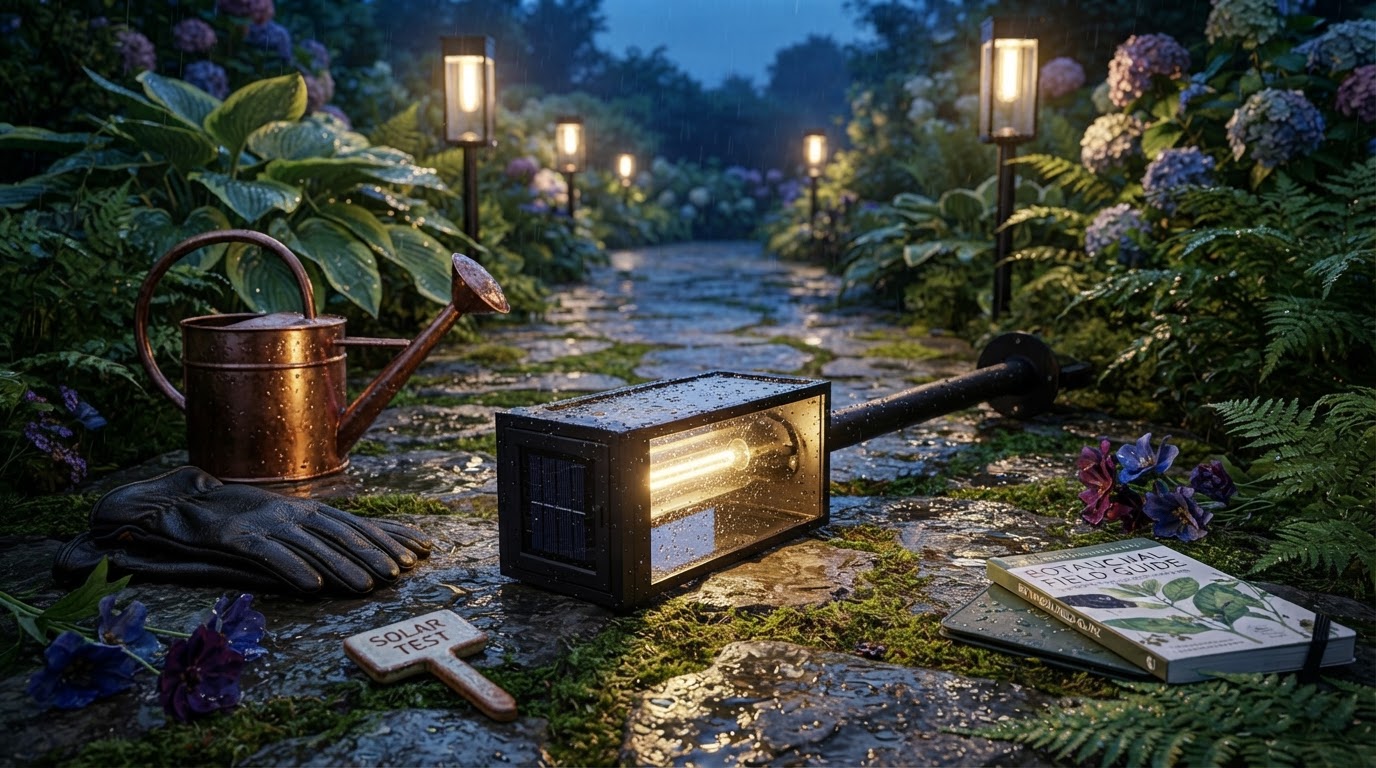
Garden Pathway Lights for Rainy Regional Climates
 Sam VasquezBuying Guide Lead
November 1, 2026. This guide examines the technical requirements for solar lighting in high-moisture environments. It is designed for homeowners who need reliable dusk to dawn illumination in regions prone to frequent storms or high humidity.
The Failure Point of Standard Solar Lighting
Most solar lights fail not because of the battery, but because of moisture ingress. When rain hits a standard garden light, capillary action can draw water into the internal housing, corroding the circuitry and causing the light to flicker or die prematurely. According to The Spruce, the best outdoor solar lights must have a verified weather resistance rating to survive consistent exposure. Without a proper seal, the transition between the solar panel and the light body becomes a gateway for water. This is particularly problematic in areas where waterproof solar pathway lights are necessary for safety. If you are shopping for a rainy climate, you cannot rely on basic plastic stakes. You need materials like cast brass or high-density polymers that won't warp or leak under pressure. Between the cheap multi-packs found at big-box stores and professional-grade fixtures, I’d go with the latter every time if you live in the Pacific Northwest or the Southeast. If you're on a budget, you might be tempted by the 12-packs, but you will likely replace them within a single season of heavy rain.
Engineering for Saturation and Low Light
Garden Pathway Lights are designed to solve the two biggest problems of rainy weather: water intrusion and limited sunlight. Our fixtures utilize high-efficiency monocrystalline panels that can pull a charge even during overcast, drizzly days. This is a critical distinction because standard polycrystalline panels often fail to reach a full charge when the sky is gray, leading to lights that turn off by midnight. When you are looking for weatherproof solar walkway lights, look for units that offer a "dusk to dawn" sensor that is protected by a recessed housing. This prevents water droplets from sitting on the sensor and tricking the light into thinking it is still daytime. Furthermore, heavy-duty construction is required for ground stability. In saturated soil, lightweight lights often lean or fall over. A heavy-duty stake system ensures the light remains vertical and functional even when the ground is soft. For those transitioning into colder months, weatherproof solar lights for winter require even more robust internal sealing to handle the expansion and contraction of freezing water. Skip this if you live in an arid desert environment where moisture is never a concern; in those cases, you can prioritize aesthetics over ingress protection.
The Rainy Climate Selection Framework
Choosing the right fixture involves more than just looking at the brightness. You need to evaluate the Ingress Protection (IP) rating and the material composition. Here's what I'd actually buy for a truly wet garden: a fixture with a minimum IP65 rating and a glass—not plastic—lens. Plastic lenses tend to cloud over when exposed to constant moisture and UV rays, which eventually blocks the light output. If you are comparing options, VOLT Lighting offers durable cast brass construction that is essentially impervious to rain, though it comes at a higher price point than consumer-grade kits. For a more balanced approach, the best solar lights for rainy climates usually feature a combination of stainless steel and sealed gaskets. Before you make a purchase, run through this checklist:
- Verify the IP rating is at least IP44 for splash resistance, though IP65 is preferred for heavy rain.
- Check for a glass lens to ensure long-term clarity in humid conditions.
- Ensure the solar panel is integrated with a seamless seal to the main body.
- Look for "dusk to dawn" automatic sensors that are shielded from direct water contact.
- Select a heavy-duty stake or mounting base to prevent leaning in wet, muddy soil.
- Confirm the battery compartment is accessible but double-gasketed.
Shop Garden Pathway Lights here