Solar Path Lighting for a Very Small Front Garden: FAQ
A very small front garden usually needs two or three pathway lights, not a row of eight. Once a frontage is under about 15 feet deep, the constraint stops being how to light the path and becomes how to avoid overwhelming a space where every fixture is visible from the street, the doorstep, and the front window at the same time. Restraint reads as designed; a dense row reads as a landing strip.
Below are the questions that come up most often about lighting a compact frontage, a courtyard forecourt, or a short path from gate to door.
How many lights does a small frontage actually need?
Enough to mark the beginning, the end, and any hazard between them. On a short path that is often two lights; on a path with a step it is three.
| Frontage | Typical path length | Sensible number of lights | Where they go | |---|---|---|---| | Paved forecourt, no path as such | Under 8 feet | 1 to 2 | One at the boundary edge, one near the door | | Short straight path, gate to door | 8 to 15 feet | 2 to 3 | Both ends, plus any step | | Small path with a turn | 10 to 20 feet | 3 | Entrance, the turn, the door | | Small garden with a side passage | Varies | 2 front, 1 at the passage mouth | Mark the side route rather than lining it |
The instinct to fill the path evenly comes from larger gardens, where the run of lights is the design. In a compact space the house frontage is the design, and the lights are there to show the ground. For longer runs where even spacing does matter, the walkway planning guide covers the arithmetic.
Why does over-lighting a small garden look worse?
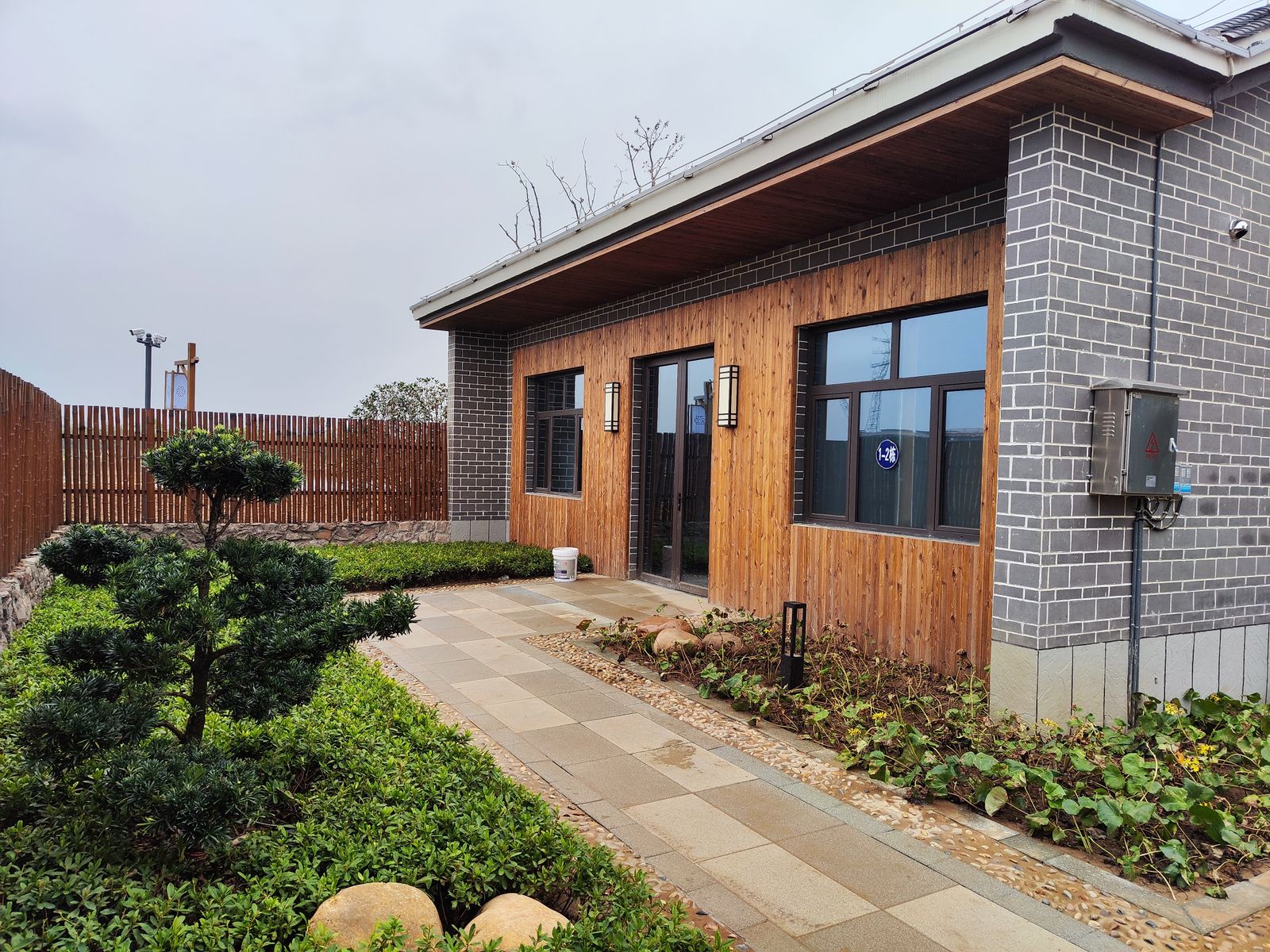
Because the eye takes in the whole space at once. In a large garden, a viewer sees a section of the lighting at a time and reads it as a receding line. In a small one, every fixture is in a single field of view, so eight lights across 12 feet look like a row of markers rather than a lit path.
There are two practical consequences as well. Closely spaced lights overlap their pools of light and flatten the surface, which removes exactly the shadow definition that shows an uneven paver or a lifted slab. And a small garden puts fixtures close to windows, so an over-lit frontage becomes visible glare from inside the front room after dark.
Spacing that would be too wide on a long path is often correct on a short one. If two lights and the doorway give continuous guidance, that is a finished job.
Does staggering work in a tiny space?
Rarely. Staggered layouts rely on distance for the alternating rhythm to register; over a 10-foot run, alternate sides just look accidental. On a small frontage a single-sided run usually looks more deliberate and leaves the other side free for planting or pots.
The exception is a small garden where the path splits — one branch to the door, one to a bin store or side gate. There, one light on each branch at the junction reads clearly as a fork rather than a line. The wider comparison between the two layouts is in staggered against straight pathway layouts.
Placement rules specific to compact frontages
That last point is the real constraint on compact plots. The Waterproof Solar Garden Pathway Lights with Automatic On And Off need daylight on the panel and nothing else — no cable route, no socket, no transformer to hide in a space that has nowhere to hide anything. In a small garden that absence of infrastructure matters as much as the light itself, because there is no room for a junction box or a trench.
Making a small frontage look intentional

Small spaces reward consistency more than variety. Three ideas that work reliably.
- One fixture type, one height. Mixed heights are the fastest way to make a compact garden look cluttered after dark.
- Light the boundary, not the middle. Fixtures at the outer edges push the perceived width outward. Lights down the center of a small space make it feel narrower.
- Let something take the light. A pot, a clipped shrub, or a low wall next to a fixture gives the light something to model, which reads as depth rather than as a bare bulb in the dark.
Frequently asked questions
Is one solar light enough for a very short path? It can be, if the path is straight, level, and the door already contributes some light. Place it at the point of greatest uncertainty, which is usually where the public footpath meets your ground rather than next to the door. Two lights is the safer default because it establishes a line rather than a spot.
Can pathway lights be used in a fully paved front garden? Yes, with a different mounting approach. Stakes need soil, so a fully paved forecourt needs planters, a gravel strip, a border along the boundary, or a raised bed to hold the units. A pot at each side of the door works well and keeps the paving clear.
Will lights this close to the street be a nuisance to neighbors or drivers? Not if they are low and aimed down, which is how pathway fixtures are designed to work. The problems come from high, angled, or wide-beam fixtures. On a compact frontage, keeping every fixture below knee height and pointed at the ground avoids the issue entirely.
Do small gardens have worse solar charging? Often, yes, because buildings, walls, and fences take up a larger share of the sky view. It is worth watching where the sun actually lands for a day before committing to positions, and accepting that the best charging spot may be a pot near the boundary rather than a stake tucked beside the door.
Next step
Stand at your gate after dark with the porch light off and identify the two moments of uncertainty on the way in: where the path starts and where the level changes. Light those two points, live with it for a week, and only add a third if something still feels unclear. In a small garden, two lights placed well beat six placed evenly.
Cover photo by suzukii xingfu on Pexels.